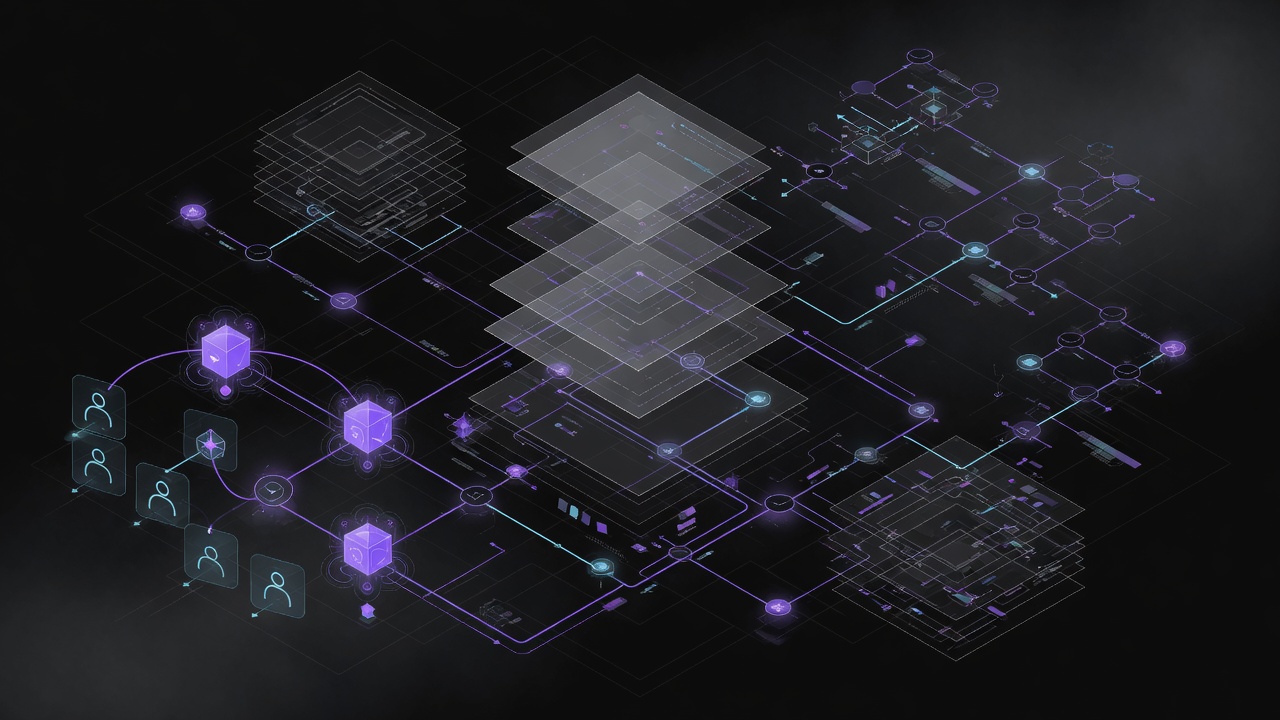
Most agentic products do not create value alone. They need access to customer systems, partner data, external tools, human operators, and permission to act across boundaries. This makes ecosystem design central: the venture is not only designing an agent's behaviour, it is designing the trust, incentive, and accountability system around every participant.
An integration is a relationship, not a connector
An API connection may be technically simple while the commercial and operational relationship is difficult. Who can authorize access? What value does the partner receive? What happens when a user revokes permission? Who supports a failed action? A venture that treats these questions as downstream implementation details often discovers that the real product constraint is ecosystem access, not model quality.
The four ecosystem contracts
Every partner or system boundary needs more than technical connectivity.
Core idea: Value compounds only when participants can see their role and their protection.
- Value contract: the explicit benefit each participant receives from joining or allowing access
- Permission contract: who grants, revokes, scopes, and audits access to data or actions
- Operating contract: what happens when the agent needs a person, a partner response, or a correction
- Economic contract: how cost, risk, support burden, and upside are allocated as usage grows
Trust boundaries are product boundaries
Users do not grant an agent permission because the interface looks polished. They grant it when they understand what it can access, what it may do, how they remain in control, and what recourse exists if it is wrong. The same is true for partners. A clear trust boundary turns abstract AI risk into a specific product choice: read-only access, draft creation, approval before action, or a narrow class of reversible writes.
- Ask for the smallest permission that proves the next useful workflow
- Make the action and source visible at the point a user grants approval
- Design revocation and offboarding before broadening access
- Give partners a view of the value and the operational load created by the integration
Sequence the ecosystem deliberately
Find the critical external actor
Identify the person, platform, or partner whose participation unlocks the core workflow.
- Map the dependency
- Name the alternative if access is delayed
Prove a narrow exchange
Offer a small workflow with a clear benefit and an intentionally limited permission boundary.
- Measure the partner's effort
- Show the value created for the shared customer
Operationalize trust
Add support routes, audit views, and clear accountability before expanding to more participants or actions.
- Document failure handling
- Review permission and value assumptions regularly
Agentic innovation can create new forms of coordination across an ecosystem. It only becomes durable when permission, incentive, and operational responsibility are designed with the same care as the agent itself.